
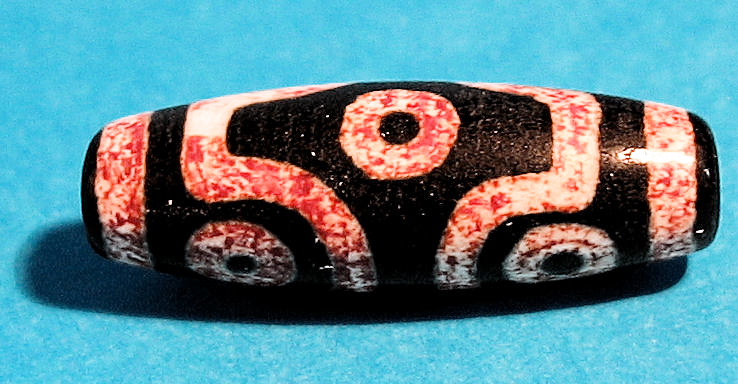
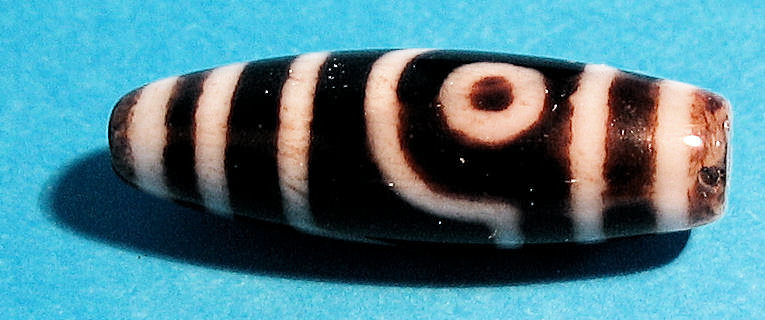
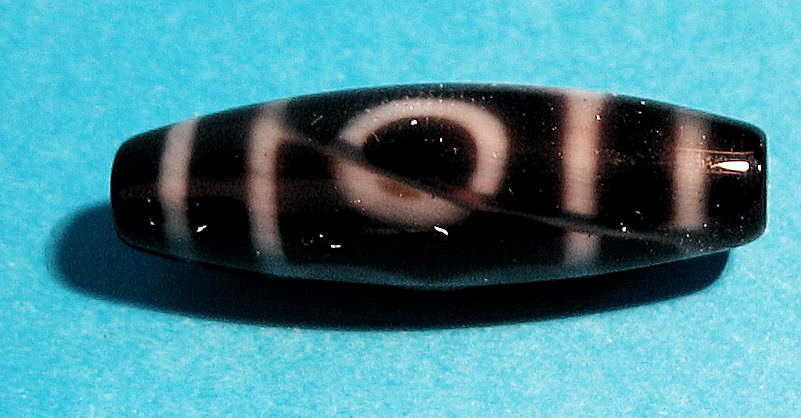
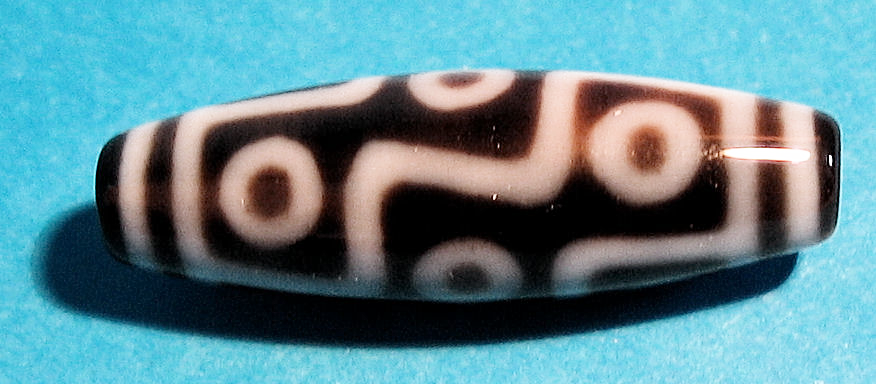
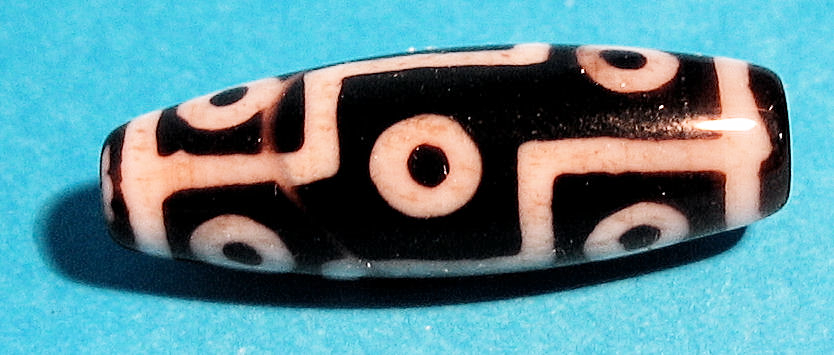
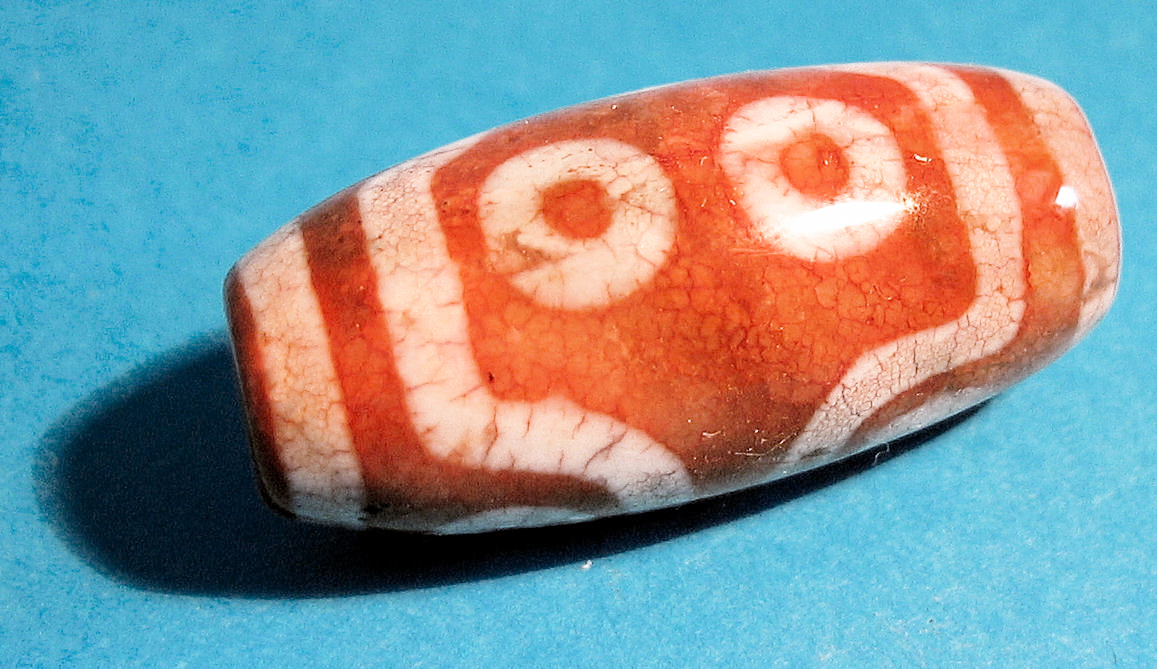
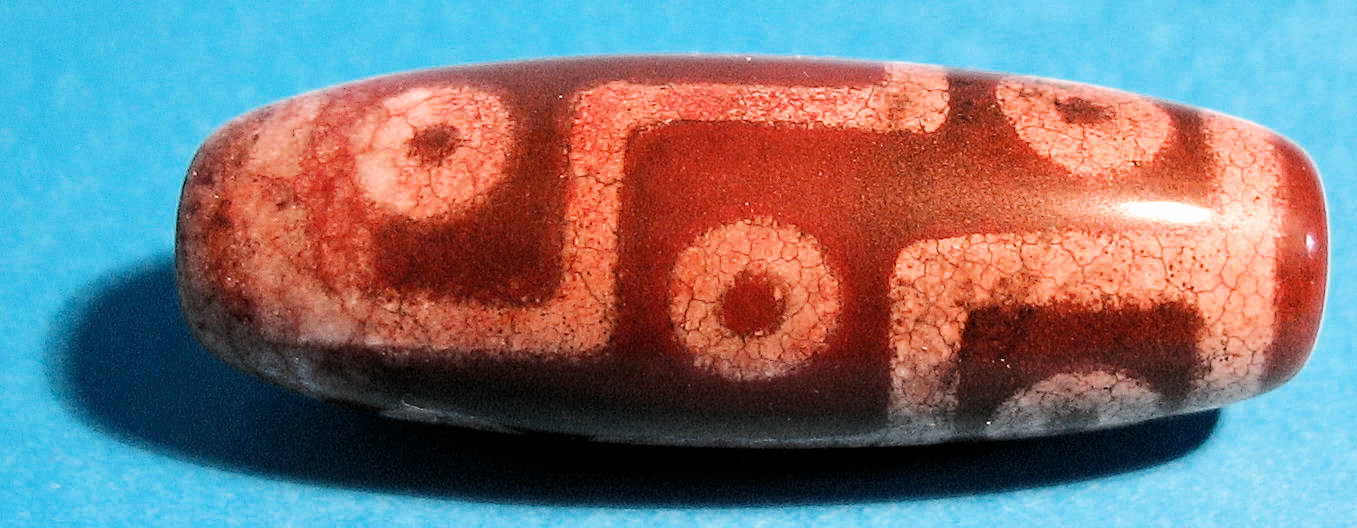
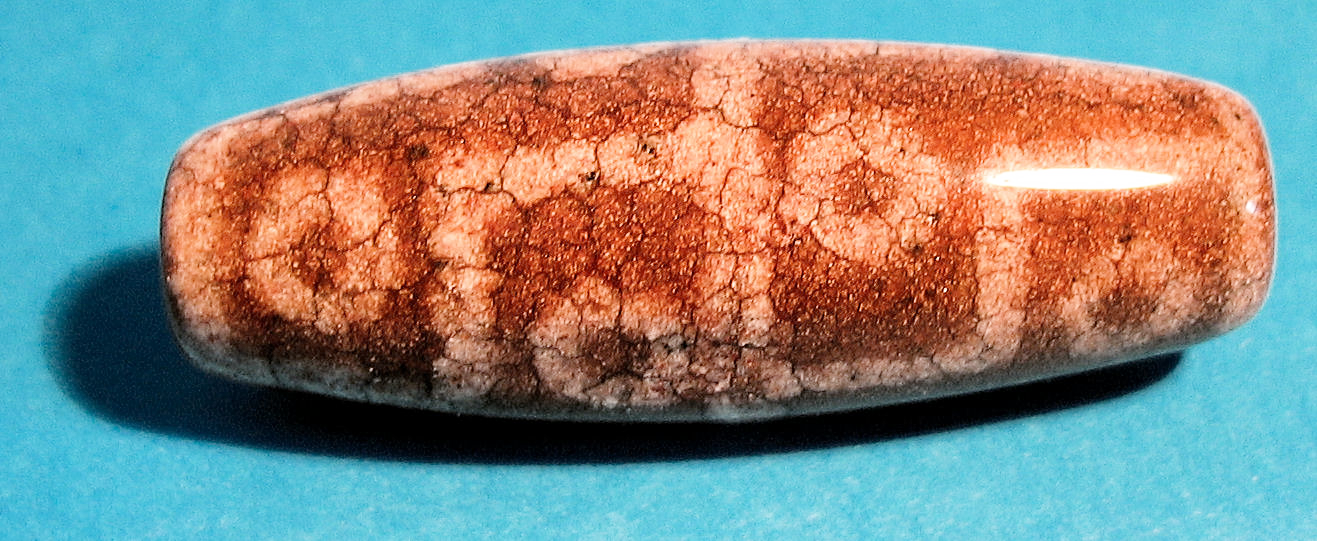
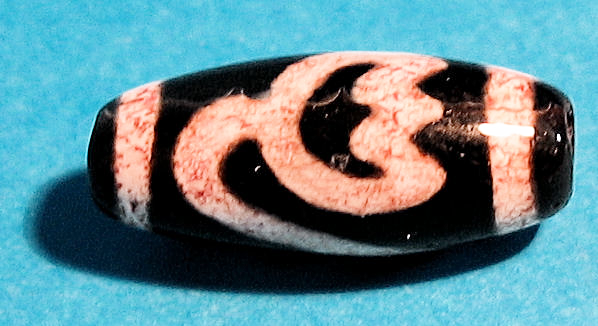
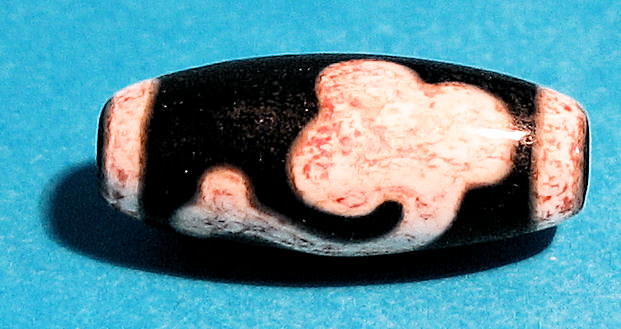
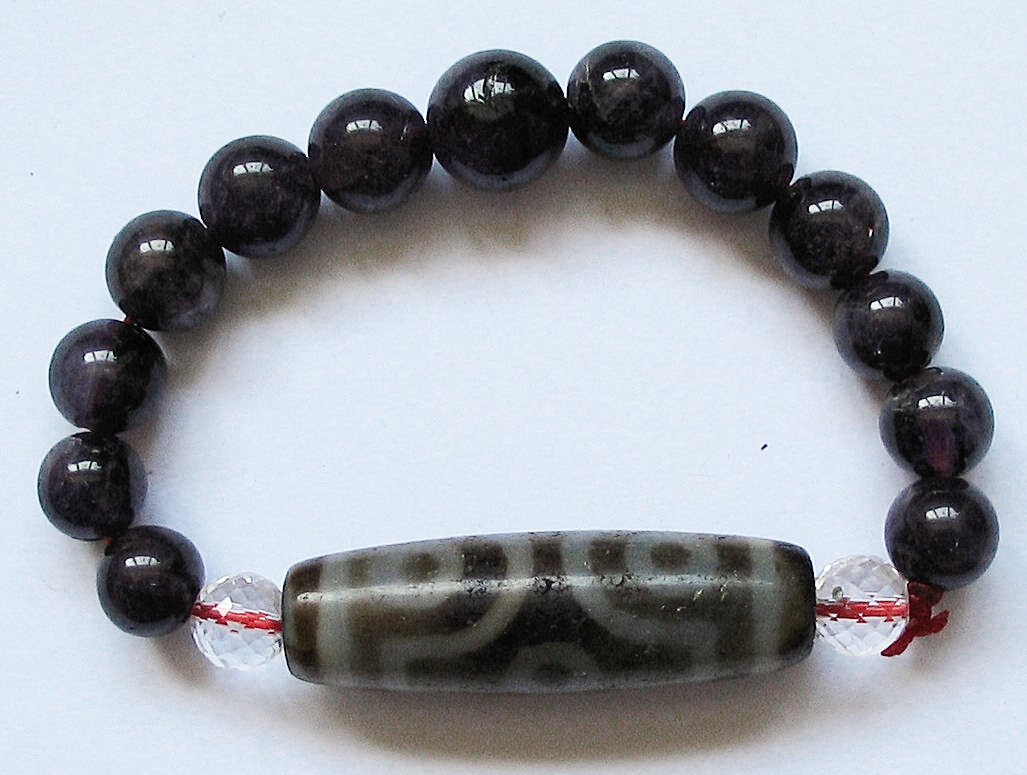
The dzi (zee) is a uniquely Tibetan stone, an agate of oblong or round shape pierced lengthways. It has a shiny black and white design, characterised by the strong eye pattern, circle and square or double wave. The most valuable dzi were those with three or nine-eyes , the best being those with sharply contrasting patterns, shiny and with a faintly oily surface.
There are many interpretations concerning the dzi 's origin. Since they are usually found
buried in the ground, it is generally thought that they were made and worn by people in
prehistoric or neolithic times. There are more mystical interpretations, some being that
the dzi were once worm-like insects which, when frightened, froze and turned to stone.
Other stories relate how the dzi were once ornaments of the demi-gods who threw away when
they became damaged, which accounts for why so few of the beads are in a perfect
unblemished state. They were said to appear in miraculous ways, sometimes as presents
from local deities to humans who had rendered them service and appearing out of rabbit
holes or on bushes which bore them like fruit. The dzi is either worn as a single bead
about the neck, mainly for its auspicious or medicinal value, or in a traditional necklace
interspersed with coral, pearls, amber or turquoise, or even, if the owner is fortunate
to have a collection of dzi , a whole necklace is made from the stones. Dzi are also used
when applying gold to thankas or writing in gold, to burnish it and bring out the sheen.
Many jewels are worn for their medicinal properties. It is said that dzi protects its wearer
from strokes and other sicknesses, as well as from evil influences. If, while it is being
worn, the bead is in any way damaged or broken, it is taken as a sign that the bead has
performed its task and absorbed the shock of the super-natural attack, though the dzi is
then rendered useless for any further protection.
Precious pills, which contain most of these ingredients, also play an important part in
curing many physical disorders. The Rinchen Ratna Samphel, (the Precious Wish Fulfilling
Jewel), is compared to a precious jewel from the king of medicines. It contains over 100
different ingredients including Ngochu Tsothel, (a preparation of purified mercury, surplur
and sixteen different metals and minerals developed by the thirteenth century Tibetan
scholar, Khedup Ugen Rinchen Pal ), as well as seventy other ingredients such as purified
gold, silver, copper, iron, lead and lode-stone. More notably the pill contains gems as
coral, turquoise, pearls, lapis, lazuli and dzi . The precious jewels are detoxified and
then ground into a fine powder to be mixed with a number of other organic and mineral materials.
Price: $388.97 |

Price: $188.97 |
Price: $248.97 |
Price: $318.97 |

Price: $398.97 |
Price: $488.97 |
Price: $498.97 |
Price: $638.97 |
Price: $888.97 |
Price: $988.97 |

Price: $438.97 |
Price: $248.97 |
Price: $368.97 |

Price: $278.97 |

Price: $348.97 |
Price: $448.97 |