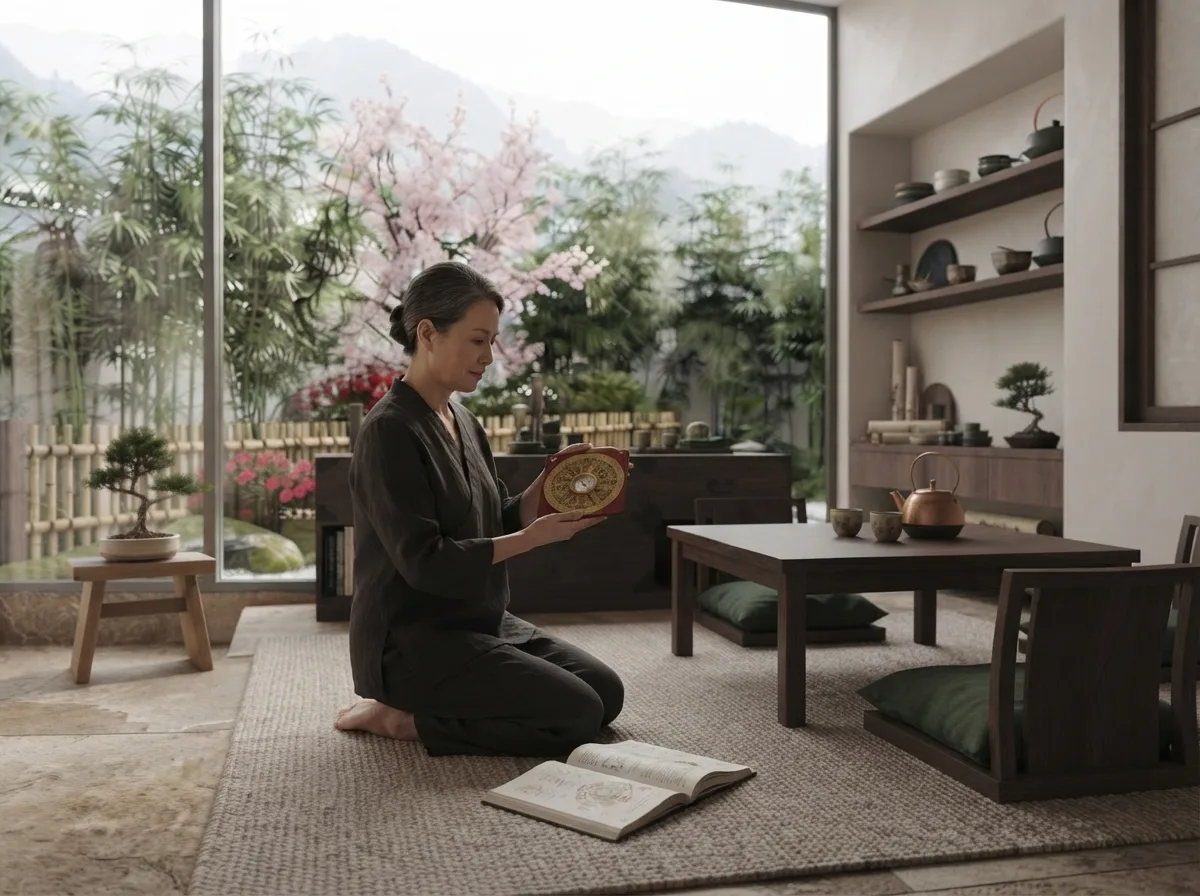
Feng Shui directions are an important part of traditional Feng Shui practice. The direction a home faces, the position of important rooms, and the direction in which a person works, sleeps or studies can all be considered when creating a balanced living environment.
In traditional Chinese metaphysics, the eight compass directions are associated with different qualities, energies and areas of life. Understanding these directions can provide useful guidance when planning the layout of a home, office or personal space.
What Are Feng Shui Directions?
Feng Shui directions refer primarily to the eight compass directions: North, South, East, West, Northeast, Northwest, Southeast and Southwest.
Each direction has traditionally been associated with particular elemental qualities, energies and symbolic meanings. These associations are commonly used together with the Bagua, Five Elements and other Feng Shui principles.
A compass is therefore an important tool in Feng Shui because it helps determine the orientation and direction of a property or particular area within a property.
Why Are Directions Important in Feng Shui?
Feng Shui is based on the traditional idea that the environment influences how Qi, or life energy, moves through a space. The orientation and arrangement of a property are therefore important considerations when evaluating its Feng Shui characteristics.
Directions may be considered when deciding the placement of entrances, bedrooms, desks, kitchens and other important areas. Personal Feng Shui systems may also use an individual's birth information to identify directions traditionally regarded as more favourable or less favourable.
However, direction should not be considered in isolation. A comprehensive Feng Shui assessment may also take into account the building's layout, surrounding environment, forms, entrances, internal arrangement, Five Elements and other relevant factors.
The Eight Feng Shui Directions
The eight main directions form the foundation of many traditional Feng Shui analyses. Each direction has its own symbolic associations.
Direction Traditional Element Common Associations North Water Career, life path and movement South Fire Recognition, reputation and visibility East Wood Family, growth and vitality West Metal Creativity, children and completion Northeast Earth Knowledge, learning and personal development Northwest Metal Helpful people, mentors and travel Southeast Wood Wealth, prosperity and abundance Southwest Earth Relationships, partnership and harmonyNorth: Career and Life Direction
North is traditionally associated with the Water element and is commonly connected with career, life direction and personal movement.
In a Feng Shui assessment, the northern area of a property may therefore be examined when considering career-related matters and the flow of opportunities.
Maintaining a clean, organised and functional northern area is a simple traditional Feng Shui practice. However, the appropriate treatment depends on the overall characteristics of the property.
South: Recognition and Reputation
South is traditionally associated with the Fire element and is linked with recognition, reputation, visibility and expression.
For people who work in public-facing careers, leadership roles or creative fields, the symbolism of the southern sector may be of particular interest.
East: Family, Growth and Vitality
East is traditionally associated with the Wood element. It is commonly connected with family, growth, development and vitality.
The eastern sector can therefore be considered when analysing family-related areas and the overall sense of growth within a household.
West: Creativity and Children
West is traditionally associated with the Metal element and is commonly connected with creativity, children and the completion of projects.
This direction may be particularly interesting when designing spaces intended for creative activities, hobbies or family interaction.
Northeast: Knowledge and Learning
Northeast is traditionally associated with the Earth element and is commonly connected with knowledge, education, concentration and personal development.
Traditionally, this sector may be considered when arranging a study room, library or learning environment.
Northwest: Helpful People and Support
Northwest is traditionally associated with the Metal element. It is commonly connected with mentors, helpful people, guidance, networking and travel.
From a traditional Feng Shui perspective, a balanced northwest sector may symbolise access to support and useful connections.
Southeast: Wealth and Prosperity
Southeast is traditionally associated with the Wood element and is widely associated with wealth, prosperity, abundance and financial growth.
Because of this association, the southeast sector is often given particular attention in traditional Feng Shui discussions about wealth.
It is important to remember that simply activating a particular direction does not guarantee financial success. Traditional Feng Shui considers the property as a whole rather than relying on one direction alone.
Southwest: Relationships and Partnership
Southwest is traditionally associated with the Earth element and is commonly connected with relationships, partnership, marriage and harmony.
This sector may be considered when analysing relationship-related aspects of a home. A balanced and comfortable environment is often viewed as more important than simply adding symbolic objects.
Personal Feng Shui Directions and Kua Number
Property directions and personal directions are not necessarily the same thing. One traditional method of determining personal directions is through the Kua Number.
A person's Kua Number is traditionally calculated using birth year and gender. It is then used to identify a group of directions that are considered more favourable for that individual.
Personal directions may be considered when positioning a bed, desk, chair or other important personal spaces.
This approach is sometimes referred to as Eight Mansions Feng Shui, or Ba Zhai.
The Four Auspicious Personal Directions
In Eight Mansions Feng Shui, the four favourable directions are traditionally known as:
- Sheng Qi – commonly associated with growth, prosperity and opportunities.
- Tian Yi – traditionally associated with support, wellbeing and helpful influences.
- Yan Nian – associated with relationships, harmony and longevity.
- Fu Wei – associated with stability, concentration and personal development.
The exact compass direction corresponding to each of these categories depends on the individual's Kua Number.
How to Use Feng Shui Directions in Your Home
Understanding directions can be useful when planning or reviewing the arrangement of a home. Some practical areas to consider include:
- Entrance: Determine the orientation of the property and understand how the entrance relates to the overall layout.
- Bedroom: Consider the position and orientation of the bed, especially in relation to personal directions.
- Work Desk: Consider facing a traditionally favourable personal direction when working or studying.
- Study Area: Create a quiet, organised environment that supports concentration and learning.
- Living Room: Maintain good circulation and avoid unnecessary clutter that may interfere with the functionality of the space.
Feng Shui Directions Should Not Be Used Alone
One of the most common misunderstandings about Feng Shui is the belief that choosing a single favourable direction automatically produces positive results.
Traditional Feng Shui is considerably more comprehensive. Depending on the school of Feng Shui being used, an analysis may consider the property's orientation, external environment, internal forms, entrances, room locations, Five Elements, time periods and personal information.
Therefore, a favourable direction should be viewed as one component of a broader Feng Shui assessment rather than a guaranteed solution to a particular problem.
Why Accurate Direction Matters
An inaccurate compass reading can lead to an incorrect Feng Shui assessment. This is particularly important when working with precise compass sectors or personal directions.
When conducting a Feng Shui assessment, it is useful to take multiple compass readings from appropriate locations and avoid strong sources of magnetic interference where possible.
For advanced Feng Shui analysis, the practitioner may also need to determine the property's facing direction and sitting direction according to the particular Feng Shui methodology being applied.
Feng Shui Directions and the Five Elements
Directions and the Five Elements are closely connected in many traditional Feng Shui systems.
The traditional associations are:
- North: Water
- South: Fire
- East: Wood
- Southeast: Wood
- Northeast: Earth
- Southwest: Earth
- West: Metal
- Northwest: Metal
These elemental relationships can be used as part of a broader analysis to understand whether particular areas of a property are traditionally considered balanced or require adjustment.
Simple Feng Shui Direction Tips
You do not necessarily need to make major changes to your home to begin applying basic Feng Shui principles. Consider these simple practices:
- Keep important areas clean and free from unnecessary clutter.
- Ensure doors and pathways can open and function properly.
- Maintain good natural light and ventilation where practical.
- Consider your personal favourable direction when positioning a desk or chair.
- Keep the bedroom comfortable and peaceful.
- Avoid relying on symbolic objects without considering the overall environment.
- Use compass directions together with the broader Feng Shui layout.
Conclusion
Feng Shui directions provide an important framework for understanding how orientation, space and traditional elemental associations are interpreted in Feng Shui.
The eight directions are traditionally connected with different areas of life, including career, recognition, family, creativity, knowledge, helpful people, wealth and relationships.
Personal Feng Shui can go one step further by using the Kua Number to identify directions traditionally considered more favourable for an individual.
Ultimately, Feng Shui works best as a holistic system. Direction, layout, environment, Five Elements and personal factors should be considered together rather than treating one direction as a guaranteed source of luck or success.
Discover Your Personal Feng Shui Directions
Want to know which Feng Shui directions are traditionally considered favourable for you? Use our free Kua Number analysis to discover your personal Feng Shui group and auspicious directions.
Calculate Your Kua NumberDisclaimer
Feng Shui is a traditional Chinese practice and the information in this article is provided for educational and cultural purposes. Feng Shui interpretations vary between different schools and practitioners. The information presented here should not be considered a guarantee of financial, health, relationship or other outcomes.