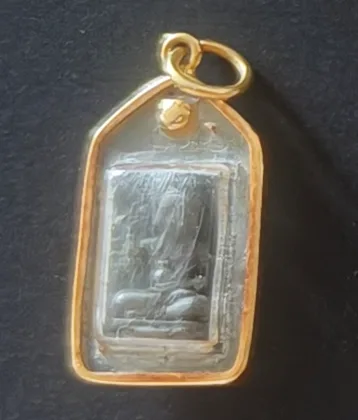
 Hover to view full image
TA-018 · available
Kuman Thong Amulet – Traditional Thai Talisman of Protection and Fortune
The Kuman Thong Amulet, commonly known in Thai as กุมารทอง, is one of the most distinctive and recognizable forms of Thai spiritual talismans. The tradition has deep roots in Thai folklore and religious culture and has developed through a combination of Buddhist practices, local beliefs, protective traditions, and spiritual customs.
The term "Kuman Thong" is commonly translated as "Golden Boy." Traditional representations are often associated with a young child or guardian spirit and are believed by devotees to provide spiritual protection, assistance, good fortune, and support in daily life.
Kuman Thong should be understood within the context of Thai cultural and spiritual traditions. Beliefs concerning spirits, guardian entities, prosperity, and supernatural protection vary significantly between communities, temples, practitioners, and individual devotees. These traditional beliefs are matters of religion and culture rather than scientifically established effects.
Historically, Kuman Thong traditions have been described in Thai folklore and literature in several forms. Some traditional accounts involve powerful spiritual practices and materials that are very different from the blessed amulets commonly produced by temples today. Modern temple-issued Kuman Thong amulets are generally produced using consecrated materials and are often created as devotional or commemorative objects.
Materials used for Kuman Thong vary greatly according to the particular edition. Modern examples may be made from sacred clay, blessed powder, wood, metal, resin, or other materials. Some editions may incorporate additional consecrated substances or inscriptions according to the temple's tradition.
The appearance of Kuman Thong also differs considerably. Some examples depict a standing or seated child, while others use symbolic figures, miniature statues, plaques, or amulet-style forms. The design, inscriptions, base markings, material, and consecration ceremony can help identify a particular edition.
For collectors, establishing the exact origin of a Kuman Thong is especially important. Unlike amulet categories associated with a single historical temple or monk, Kuman Thong encompasses numerous editions from different temples and spiritual traditions. The same general design may therefore exist in several different versions.
Important identification factors can include the temple of origin, issuing monk or master, production year, edition name or number, material, dimensions, inscriptions, casting or molding characteristics, serial numbers, accompanying certificates, and provenance.
Temple-issued Kuman Thong from recognized masters may be accompanied by documentation describing the consecration ceremony and production details. Collectors should retain original certificates, boxes, temple documentation, and other provenance whenever available.
Kuman Thong is also an important example of the diversity of Thai religious culture. Its popularity reflects the long-standing Thai tradition of combining Buddhist devotion with local customs, protective beliefs, and household spiritual practices.
For devotees, a Kuman Thong may be regarded as a symbolic spiritual companion or guardian. For collectors, it can also represent an interesting piece of Thai cultural history, religious art, and traditional craftsmanship.
Because Kuman Thong has many different forms and editions, buyers and collectors should avoid relying solely on photographs or general descriptions when determining authenticity or historical value. A specific example should be evaluated according to its documented temple origin, maker, production period, materials, physical characteristics, and provenance.
- Temple
- Various temples and individual Thai spiritual traditions
- Monk
- Various monks and spiritual masters, depending on the edition
- Material
- Traditionally associated with sacred substances and consecrated materials from blessed clay, wood, metal, resin, powder