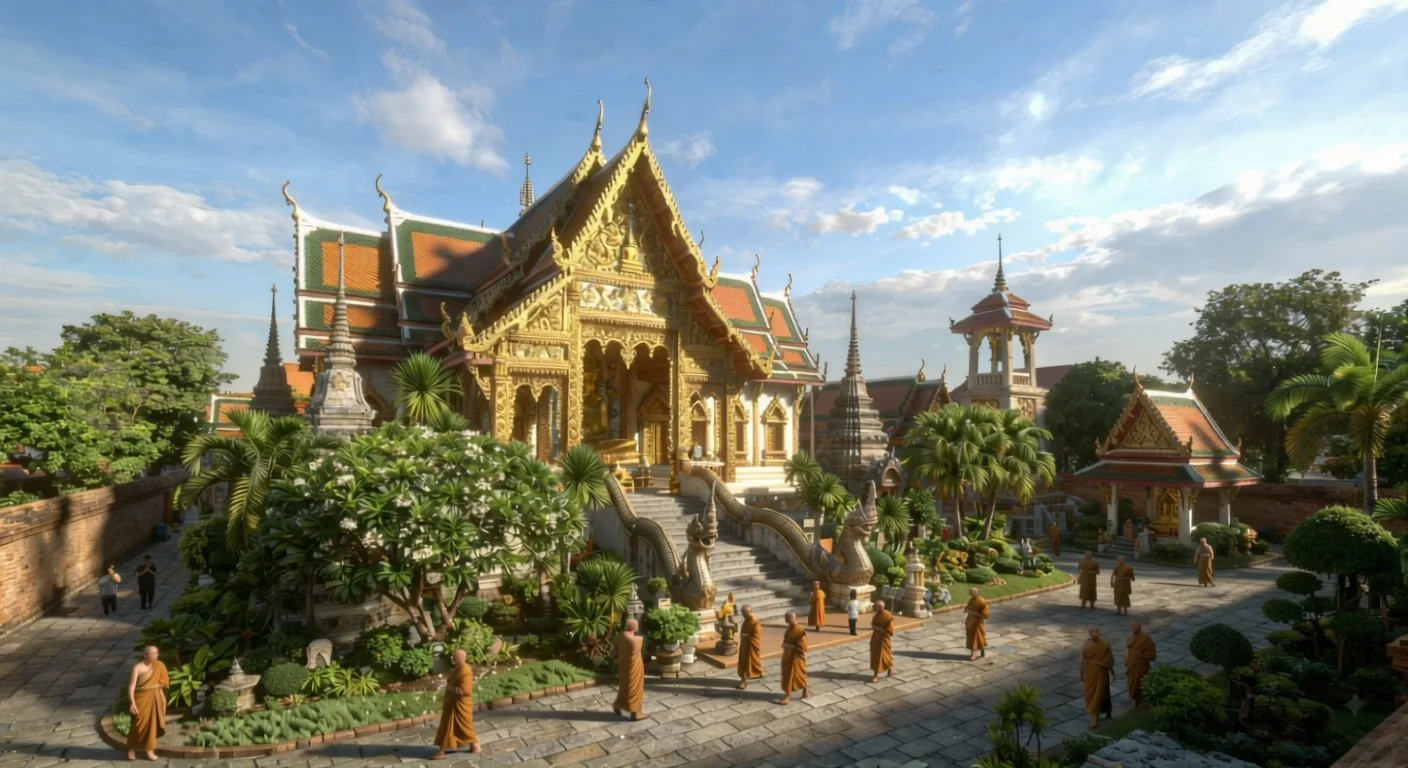
Wat Thepsirin Tharawat: A Historic Royal Temple in Bangkok
Wat Thepsirin Tharawat Ratchaworawihan (วัดเทพศิรินทราวาสราชวรวิหาร), commonly known as Wat Thepsirin, is one of Bangkok's important historic royal temples. Located along Krung Kasem Road in the Pom Prap Sattru Phai District, the temple occupies an important position in the religious and architectural history of the Rattanakosin period.
The temple was commissioned by King Chulalongkorn (Rama V) in memory of his mother, Queen Thepsirin. Its foundation therefore has a deeply personal royal significance, while its architectural design reflects the changing artistic and cultural environment of Thailand during the late nineteenth century.
Wat Thepsirin is particularly noteworthy because its architecture combines traditional Thai Buddhist forms with Western-influenced decorative and structural elements. This combination reflects the broader transformation of Siam during the reigns of Kings Rama IV and Rama V, when Thai artists and architects increasingly adapted foreign ideas while preserving important elements of Thai Buddhist design.
Today, Wat Thepsirin remains both a functioning Buddhist monastery and an important heritage site. Its religious significance, royal connections, architecture and historical associations make it an important destination for people interested in Thai Buddhism and Bangkok's cultural history.
The Foundation of Wat Thepsirin
Wat Thepsirin was established during the reign of King Chulalongkorn (Rama V), who ruled Siam from 1868 to 1910.
The temple was created as a royal act of merit dedicated to his mother, Queen Thepsirin. According to architectural research from Silpakorn University, King Rama V intended the temple to serve as a temple associated with the royal lineage of Queen Thepsirin and commissioned it as an act of royal merit in her memory.
This background gives Wat Thepsirin a different character from many older Bangkok temples. Its creation was closely connected with the royal family and with the practice of dedicating religious foundations to deceased members of the royal household.
The temple consequently became an important part of the royal religious landscape of Bangkok during the late nineteenth century.
Queen Thepsirin
Queen Thepsirin, whose name is preserved in the temple's name, was the mother of King Rama V.
The temple's dedication reflects the importance of filial devotion within Thai royal tradition. Establishing a Buddhist temple in memory of a parent allowed the monarch to make merit and create a lasting religious monument associated with the person's memory.
The name เทพศิรินทราวาส therefore carries a direct connection with Queen Thepsirin and remains a permanent reminder of her place within Thailand's royal history.
Wat Thepsirin as a Royal Temple
Wat Thepsirin is classified as a Phra Aram Luang, a royal temple, and is recognised as a Ratchaworawihan.
Royal temples have historically played an important role in Thai Buddhist society. They are associated with the monarchy, religious ceremonies and the preservation of important Buddhist traditions.
The status of Wat Thepsirin reflects its historical relationship with the Chakri royal family and the circumstances surrounding its establishment.
Its royal connections also help explain the sophistication of its architectural design and the care devoted to its religious buildings and decorative programme.
Wat Thepsirin and Bangkok's Rattanakosin Heritage
Wat Thepsirin belongs to the broader architectural and religious heritage of Bangkok's Rattanakosin era.
During the nineteenth century, Bangkok underwent significant political, economic and cultural changes. The city was developing into a modern capital while maintaining the religious traditions that had shaped Siamese society for centuries.
Wat Thepsirin provides an excellent example of this period of transition.
Its architecture demonstrates how traditional Buddhist forms could be combined with new artistic influences without abandoning the fundamental identity of a Thai Buddhist temple.
The Architecture of Wat Thepsirin
One of the most important features of Wat Thepsirin is its distinctive architecture.
Research conducted by the Faculty of Architecture at Silpakorn University identifies the temple as an important example of architectural experimentation during the period. Its design incorporates elements inherited from the architectural ideas of the reign of King Rama IV while also introducing Western artistic influences.
The result is an architectural style that combines Thai Buddhist traditions with selected Western elements.
This makes Wat Thepsirin especially valuable for students of Thai architecture because it demonstrates how artistic traditions evolved during a period when Siam was increasingly interacting with Western powers.
The Ubosot
The ubosot, or ordination hall, is one of the principal sacred structures within Wat Thepsirin.
The design incorporates traditional Thai elements while also displaying influences from architectural styles associated with the nineteenth-century modernisation of Siam.
Architectural research identifies features such as crown-shaped decorative arches, traditional Thai ceramic ornamentation, curved ceilings and Western-influenced decorative treatment as important characteristics of the building.
The combination is particularly significant because the Western elements were not simply copied. They were adapted within a Thai decorative framework.
Thai and Western Architectural Influences
Wat Thepsirin demonstrates the ability of Thai craftsmen to incorporate foreign artistic concepts while maintaining local cultural identity.
Western architectural influences can be observed in certain structural and decorative features, while Thai artistic principles remain visible in the overall organisation and ornamentation of the temple.
This synthesis reflects the wider intellectual environment of nineteenth-century Siam, when the country was actively adapting new knowledge and technologies in response to changing international circumstances.
The architectural history of Wat Thepsirin therefore provides an example of how religious architecture participated in Thailand's broader process of cultural adaptation and modernisation.
The Symbolism of the Temple Layout
The design of Wat Thepsirin was not simply an exercise in decoration.
Architectural research indicates that Buddhist concepts, religious symbolism and references to Buddhist history were incorporated into the planning of the temple grounds. Trees associated with important episodes in the Buddha's life were used symbolically within the temple's sacred landscape.
This demonstrates how Thai temple architecture can communicate Buddhist ideas through spatial planning as well as through images, inscriptions and ornamentation.
The Buddhist Meaning of the Sacred Boundary
The sema, or sacred boundary markers, are fundamental elements of a Thai Buddhist ordination area.
At Wat Thepsirin, the arrangement of the sacred boundary was incorporated into the broader architectural concept of the temple.
Architectural research suggests that the designers interpreted Buddhist canonical ideas concerning the sacred boundary and integrated them into the overall design.
This approach demonstrates the close relationship between Buddhist doctrine and architectural planning in traditional Thai temple construction.
The Influence of King Rama IV's Architectural Tradition
The architectural concept of Wat Thepsirin has important links with artistic developments associated with the reign of King Mongkut (Rama IV).
During Rama IV's reign, Thai Buddhist architecture increasingly incorporated new approaches to design and ornamentation.
Wat Thepsirin continued this development during the reign of Rama V, combining elements inherited from earlier royal architectural traditions with newer influences.
The temple therefore represents an important transitional stage in the development of Bangkok's nineteenth-century Buddhist architecture.
Royal Symbols and Decorative Elements
The temple's architecture also incorporates symbols and decorative elements associated with its royal foundation.
Architectural studies note that various architectural components, emblems and symbols were used in ways that connected the temple with its royal patron and with Queen Thepsirin, to whom the temple was dedicated.
This makes the temple's decorative programme particularly meaningful. Ornamentation is not merely aesthetic; it can also communicate historical relationships, religious ideas and royal identity.
Wat Thepsirin and Thai Buddhism
Although Wat Thepsirin is important for its architecture and royal history, it remains fundamentally a Buddhist temple.
The temple serves as a place of worship, merit-making, religious ceremonies, meditation and Buddhist community activities.
As with other Thai temples, the monastery provides a setting where monks and laypeople can participate in religious life.
Visitors can therefore appreciate Wat Thepsirin from two perspectives: as an important historical monument and as a living centre of Thai Buddhism.
Monastic Life at Wat Thepsirin
The daily life of a Thai Buddhist monastery is traditionally structured around Buddhist discipline, study, meditation and religious ceremonies.
Monks follow the Vinaya, the traditional code of monastic discipline, and participate in chanting, meditation, study and teaching.
Lay devotees may visit the temple to make offerings, observe Buddhist precepts, listen to Dhamma teachings and participate in ceremonies.
This continuing religious function is an important part of Wat Thepsirin's heritage because the temple remains a living institution rather than simply a preserved historical building.
Wat Thepsirin and Thai Buddhist Art
The temple's decorative programme illustrates the high level of craftsmanship achieved during the late nineteenth century.
Traditional Thai decorative principles are combined with carefully adapted Western elements, producing a distinctive visual character.
Interior decoration, doors, windows and ceiling details contribute to the overall artistic unity of the temple.
Architectural research specifically notes the use of Thai decorative frameworks combined with Western-influenced patterns and techniques.
This artistic combination makes Wat Thepsirin an important reference point for understanding the development of Thai Buddhist architecture during the transition into the modern era.
Wat Thepsirin and the Debsirindra School
Wat Thepsirin is also closely associated with Debsirin School, one of Bangkok's well-known educational institutions.
The school is located adjacent to the temple and shares the historical environment of the Wat Thepsirin complex.
The relationship between temple and education reflects a long-standing feature of Thai society, in which Buddhist institutions played an important role in education and the transmission of knowledge.
Today, the association between Wat Thepsirin and Debsirin School remains an important part of the area's identity.
Wat Thepsirin and Royal Memorial Tradition
The temple's original purpose as a royal act of merit provides an insight into Thailand's traditional memorial practices.
In Thai Buddhist culture, merit-making can be dedicated to deceased family members and ancestors.
For the royal family, temple construction provided a particularly enduring form of religious commemoration.
Wat Thepsirin therefore represents both a Buddhist institution and a permanent architectural expression of King Rama V's remembrance of his mother.
Wat Thepsirin and Bangkok's Cultural Heritage
Wat Thepsirin occupies an important location within Bangkok's historic urban landscape.
The temple stands in an area that developed during the expansion and modernisation of Bangkok and is situated near important transportation routes and historic urban districts.
Its proximity to Krung Kasem Road and the historic railway area places it within a part of Bangkok where nineteenth- and twentieth-century urban development can still be appreciated.
The temple's architecture provides a valuable contrast to more purely traditional Thai temple styles found elsewhere in the capital.
Wat Thepsirin and Thai Amulet Culture
For Thai amulet collectors, Wat Thepsirin can also be of interest because of its status as an important royal temple and its long Buddhist history.
However, collectors should exercise particular care when attributing a sacred object to Wat Thepsirin.
The name of a temple appearing in a dealer listing or collector discussion does not by itself establish the object's exact origin, date or consecration history.
A professional amulet record should ideally include the temple, monk, production year, material, amulet type, edition, inscription and provenance.
Where historical evidence is unavailable, an attribution should be clearly identified as an attribution rather than presented as a verified fact.
Traditional Devotional Practices
Visitors to Wat Thepsirin may participate in traditional Buddhist practices such as making merit, offering food to monks, paying respects to Buddha images, listening to Dhamma teachings and observing the Buddhist precepts.
These practices are central to Thai Buddhist life and help maintain the relationship between the temple and the wider community.
For many devotees, visiting an important royal temple can also provide an opportunity to reflect on Buddhist teachings, family relationships and the importance of making merit for loved ones.
Wat Thepsirin as a Place of Reflection
The history of Wat Thepsirin is closely connected with remembrance and merit-making.
King Rama V established the temple in memory of his mother, making the temple itself a lasting expression of filial respect.
For visitors today, this history provides an opportunity to reflect on the Buddhist practice of dedicating merit to deceased family members.
The temple consequently has significance not only as architecture but also as a place where religious practice, family remembrance and royal history intersect.
Visiting Wat Thepsirin
Wat Thepsirin is located on Krung Kasem Road in Pom Prap Sattru Phai District, Bangkok.
As an active Buddhist temple, visitors should dress modestly and behave respectfully throughout the grounds.
Visitors entering the ubosot or other sacred buildings should follow temple instructions concerning footwear, photography and appropriate conduct.
Photography should be carried out with sensitivity, especially when monks or worshippers are engaged in religious ceremonies or meditation.
Because the temple is also an important heritage site, visitors are encouraged to appreciate its architecture without disturbing religious activities.
Why Wat Thepsirin Is Important
Wat Thepsirin is important for several interconnected reasons.
- Royal heritage: The temple was established by King Rama V in memory of Queen Thepsirin.
- Buddhist heritage: It remains an active royal Buddhist temple.
- Architectural importance: Its design combines Thai traditions with Western-influenced elements.
- Historical significance: It reflects the cultural transformation of Siam during the nineteenth century.
- Educational heritage: Its close relationship with Debsirin School connects the site with Thailand's educational history.
- Urban heritage: Its location forms part of Bangkok's historic Rattanakosin-era urban landscape.
Conclusion
Wat Thepsirin Tharawat Ratchaworawihan, commonly known as Wat Thepsirin, is one of Bangkok's significant royal Buddhist temples and an outstanding example of nineteenth-century Thai architectural development.
Established by King Chulalongkorn (Rama V) in memory of his mother, Queen Thepsirin, the temple embodies the traditional Buddhist practice of making merit and dedicating religious works to a beloved parent.
Its architectural significance is equally important. The temple combines traditional Thai Buddhist design with carefully adapted Western influences, reflecting the intellectual and artistic changes taking place in Siam during the nineteenth century.
The design of the temple demonstrates that Thai architecture was not simply preserving an unchanging tradition. Instead, Thai craftsmen and architects were actively interpreting Buddhist principles, royal symbolism and foreign artistic influences to create new architectural expressions.
For visitors interested in Thai Buddhism, Wat Thepsirin provides an opportunity to experience a living royal temple. For students of architecture and history, it offers valuable insight into the transformation of Bangkok during the reigns of Rama IV and Rama V.
Above all, Wat Thepsirin remains a meaningful expression of Thai Buddhist faith, royal remembrance, architectural heritage and the continuing cultural traditions of Bangkok.