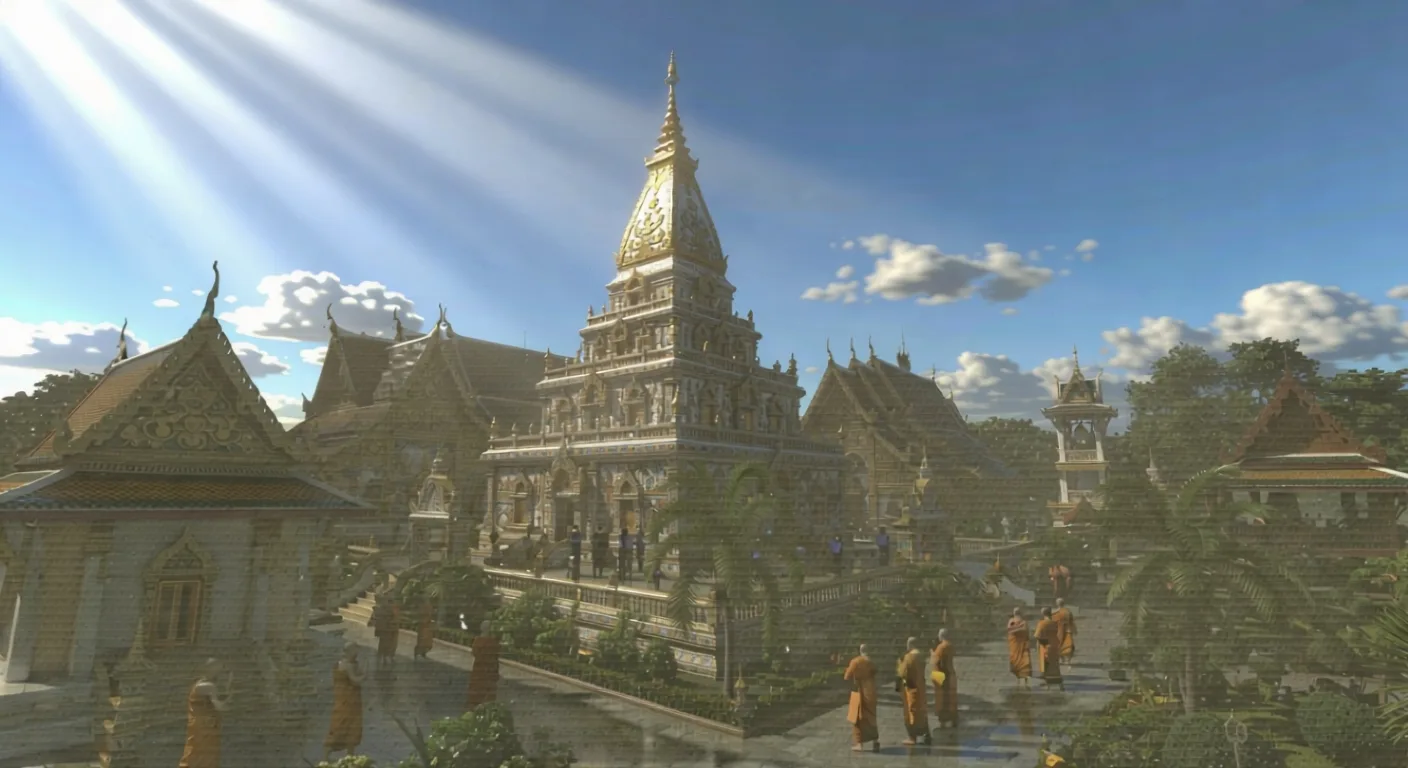
Wat Nong Bua: A Historic Tai Lue Temple in Nan
Wat Nong Bua (วัดหนองบัว) is one of the most culturally significant Buddhist temples in Nan Province, northern Thailand. Located in Ban Nong Bua, Pa Kha Subdistrict, Tha Wang Pha District, the temple is especially renowned for its traditional Tai Lue heritage, Lanna Buddhist architecture and remarkable mural paintings.
Unlike temples that are primarily famous because of a particular monk or amulet series, Wat Nong Bua is distinguished by its connection with the history and culture of the Tai Lue people. The temple provides an important window into the religious traditions, artistic expression and community life of northern Thailand.
The temple's most famous feature is the historic mural decoration inside its viharn. The paintings illustrate stories from the Panyasa Jataka, a collection of Buddhist birth stories, while also portraying details of historical society, clothing, buildings, transportation and everyday life.
Wat Nong Bua is therefore important not only as a place of Buddhist worship but also as a valuable cultural and artistic heritage site in Nan. Local and government tourism sources identify the temple as an important example of Tai Lue religious and artistic heritage.
The History of Wat Nong Bua
According to local tradition, Wat Nong Bua was established around B.E. 2405 (1862), during the reign of King Rama IV. The exact details of the temple's earliest foundation are associated with local oral history and should therefore be understood within the traditional historical context of the community.
The temple developed alongside the Tai Lue community of Ban Nong Bua. For generations, the temple served as an important religious and social centre where villagers could make merit, observe Buddhist ceremonies and maintain their cultural traditions.
The survival of the temple's historic architecture and murals provides valuable evidence of the cultural connections between Nan, the Tai Lue communities of northern Thailand and the wider artistic traditions of the former Lao and Lanna cultural regions.
Wat Nong Bua and Tai Lue Heritage
The identity of Wat Nong Bua is closely connected with the Tai Lue people, an ethnic Tai cultural community with a long history across areas of present-day southern China, Laos and northern Thailand.
Tai Lue communities developed distinctive traditions in architecture, textiles, religious art, language and village life. As communities migrated and settled in northern Thailand, they brought these traditions with them and incorporated them into the local Buddhist landscape.
Wat Nong Bua is an especially valuable example of this cultural continuity. Its architecture and murals demonstrate how Buddhist religious traditions were expressed through the artistic language and social environment of the Tai Lue community.
Visitors to the temple can therefore experience more than a historic Buddhist building. They can also gain insight into the cultural heritage of a community that has contributed significantly to the identity of northern Thailand.
The Tai Lue Viharn
The principal architectural attraction at Wat Nong Bua is its traditional Tai Lue-style viharn.
The viharn is a Buddhist assembly hall and is one of the most important religious buildings within the temple complex. Its architecture reflects the northern Thai and Tai Lue traditions that developed in the region.
The building's relatively restrained proportions and traditional decorative details create an atmosphere quite different from some of Thailand's more elaborate modern temples.
For architectural historians and visitors interested in northern Thai culture, the viharn provides an important example of how local craftsmanship and Buddhist religious requirements were brought together in a traditional temple environment.
The Famous Murals of Wat Nong Bua
The greatest artistic treasure of Wat Nong Bua is the collection of mural paintings inside the viharn.
The murals illustrate stories from the Panyasa Jataka, a collection of Buddhist narratives concerning previous lives of the Buddha. These stories traditionally communicate Buddhist moral principles through accounts of generosity, compassion, wisdom, perseverance and the consequences of one's actions.
The murals are particularly valuable because they do much more than illustrate religious stories. They also provide visual information about the society in which the paintings were created.
Scenes contain representations of people, clothing, houses, boats, weapons and other aspects of daily life. As a result, the murals can be studied as both religious art and an important visual record of historical northern Thai culture.
Thit Bua Phan – The Traditional Mural Painter
Local tradition associates the murals at Wat Nong Bua with a painter known as Thit Bua Phan, described as a Lao Phuan artist connected with the artistic traditions of the Luang Prabang region.
According to local accounts, Nai Thep, who was associated with the Nan court and was the father of the monk later known as Khruba Luang Su, brought Thit Bua Phan to Nan after military campaigns in the Muang Phuan region.
Thit Bua Phan is traditionally said to have undertaken the mural work at Wat Nong Bua with assistance from local figures including Nai Thep and Phra Saen Phichit.
Because these details derive substantially from local historical accounts and oral tradition, they are best presented as traditional attribution rather than as conclusively documented biographical fact. Nevertheless, the story is important to understanding the cultural connections represented by the murals.
The Panyasa Jataka Murals
The Panyasa Jataka murals form the central artistic narrative of Wat Nong Bua.
The Panyasa Jataka tradition contains stories of the Buddha's previous lives. Such narratives were used historically to communicate Buddhist values in an accessible form, particularly in communities where religious education was conveyed through storytelling, visual art and temple ceremonies.
The artists at Wat Nong Bua transformed these stories into detailed visual scenes. Human figures, animals, buildings and landscapes are arranged throughout the walls to create a continuous narrative environment.
Visitors should therefore look beyond the decorative beauty of the murals and consider the religious stories and moral teachings represented within them.
Historical Life Preserved in the Murals
One of the most remarkable aspects of Wat Nong Bua's murals is the amount of information they provide about historical life.
The paintings include representations of traditional clothing, architecture, boats, weapons, social activities and everyday behaviour. These details allow the murals to be studied as a visual record of the society and cultural environment of the period.
Some objects represented in the murals are particularly interesting because they demonstrate contact with technological and cultural developments entering Siam during the nineteenth century.
Among the notable images are representations interpreted as steamships and bayonets, reflecting the changing world encountered by northern communities during the reigns of King Rama IV and King Rama V.
These details make the murals valuable not only to students of Buddhist art but also to historians interested in the social history of northern Thailand.
Wat Nong Bua and the Art of Nan
Wat Nong Bua belongs to a broader tradition of religious art associated with Nan.
Nan developed its own distinctive artistic traditions while maintaining cultural connections with neighbouring areas of Laos and the wider Lanna world. Buddhist temples became important centres where these influences could be expressed through architecture, sculpture and painting.
The murals at Wat Nong Bua demonstrate this cultural interaction particularly clearly. Their style reflects connections between Nan, Tai Lue communities and artistic traditions associated with the Lao cultural region.
This makes Wat Nong Bua an important site for understanding the diversity of northern Thai Buddhist art.
Wat Nong Bua and Wat Phumin
Visitors researching Buddhist murals in Nan will often encounter comparisons between Wat Nong Bua and Wat Phumin in Nan city.
Both temples are famous for mural paintings that combine Buddhist narratives with representations of everyday society. However, their artistic traditions and individual compositions are distinct.
Wat Phumin is particularly famous for its celebrated images of people and its iconic mural scenes, while Wat Nong Bua is especially important for its Tai Lue cultural identity and its Panyasa Jataka narrative tradition.
Visiting both temples provides a valuable opportunity to appreciate the diversity of Nan's Buddhist mural heritage.
Buddhism and Community Life at Wat Nong Bua
Wat Nong Bua has traditionally functioned as more than a place of worship.
Like many historic village temples in northern Thailand, it has served as a centre for religious ceremonies, merit-making, community gatherings and the transmission of cultural traditions.
The temple's relationship with the surrounding Tai Lue community is particularly important. Buddhist practice and local cultural identity have developed together, allowing religious ceremonies, architecture, artistic traditions and village customs to reinforce one another.
This relationship explains why preserving Wat Nong Bua is important not only for Buddhism but also for the cultural heritage of the local community.
Wat Nong Bua as a Cultural Heritage Site
Wat Nong Bua is best understood as a cultural landscape in which several forms of heritage exist together.
These include the Buddhist temple, Tai Lue architecture, mural paintings, traditional craftsmanship and community history.
Each element provides a different perspective. The temple represents religious continuity; the architecture reflects local craftsmanship; the murals preserve Buddhist stories and historical imagery; and the surrounding community maintains the cultural traditions that give the site its living identity.
This combination makes Wat Nong Bua particularly valuable to anyone interested in the history of northern Thailand.
Wat Nong Bua and Thai Buddhist Art
Thai Buddhist temples are often important repositories of visual storytelling.
Before modern mass media, temple murals provided communities with a powerful way to encounter Buddhist stories. Through images, devotees could learn about the Buddha's previous lives, ethical conduct, compassion and the consequences of actions.
The murals of Wat Nong Bua demonstrate how this religious function could be combined with local artistic traditions.
The artists did not simply reproduce abstract religious symbols. They placed Buddhist narratives into a recognisable social world populated by people, buildings, clothing, animals and objects familiar to the community.
As a result, the murals remain meaningful both as religious art and as historical documentation.
Thai Lue Architecture and Craftsmanship
The architectural character of Wat Nong Bua reflects the importance of traditional craftsmanship in northern Thailand.
Tai Lue and Lanna architecture commonly makes extensive use of timber, carefully proportioned roof structures and locally developed decorative elements.
At Wat Nong Bua, these architectural characteristics contribute to the temple's sense of place and distinguish it from more modern concrete temple complexes.
Preserving such structures is important because traditional temple architecture provides evidence of the building methods, materials and aesthetic principles used by earlier generations.
Wat Nong Bua and Thai Buddhist Devotion
Although Wat Nong Bua is widely appreciated for its architecture and murals, it remains first and foremost a Buddhist temple.
Devotees visit to make merit, pray, participate in religious ceremonies and pay respects to Buddha images.
The murals themselves also have a religious function. Their stories encourage reflection on Buddhist principles and ethical conduct, allowing visitors to connect visual art with Buddhist teachings.
The temple therefore remains a living religious site rather than simply a museum of historical art.
Wat Nong Bua and Thai Amulet Culture
Unlike temples famous primarily for a particular renowned monk or amulet series, Wat Nong Bua's greatest historical significance lies in its artistic and Tai Lue cultural heritage.
Nevertheless, as an active Buddhist temple with a long history, religious objects and devotional materials associated with the temple may be of interest to students and collectors of northern Thai Buddhist culture.
Collectors should distinguish between historically documented temple issues and modern devotional objects. An item should not automatically be considered an old or rare amulet merely because it carries the name of Wat Nong Bua.
For serious research, the year of production, temple provenance, material, inscriptions, design, manufacturing method and historical documentation should be examined carefully.
Visiting Wat Nong Bua
Wat Nong Bua is located in Ban Nong Bua, Pa Kha Subdistrict, Tha Wang Pha District, Nan Province.
The temple is situated in a peaceful rural environment and can be incorporated into a cultural journey through Nan Province.
Visitors should dress respectfully and remember that Wat Nong Bua remains an active Buddhist place of worship. Appropriate clothing and quiet behaviour are recommended, particularly inside the viharn.
When viewing the murals, visitors should avoid touching painted surfaces and should follow any instructions provided by temple authorities concerning photography and access.
The murals are fragile historical works, and responsible tourism plays an important role in preserving them for future generations.
Why Wat Nong Bua Matters to Thai Cultural Heritage
Wat Nong Bua is significant because it preserves an unusually rich combination of Buddhist religion, Tai Lue culture, northern Thai architecture and historical mural painting.
The temple's murals provide insight into both Buddhist storytelling and the society of nineteenth-century northern Thailand. Their traditional association with the Lao Phuan artist Thit Bua Phan also reflects the cultural connections between Nan and the wider Lao and Tai cultural world.
The temple therefore provides an important reminder that Thailand's Buddhist heritage is not culturally uniform. Different regions and communities have developed distinctive ways of expressing Buddhist faith through architecture, art, language and tradition.
Wat Nong Bua as a Living Heritage
One of the most important qualities of Wat Nong Bua is that its heritage remains connected with a living community.
The temple is not simply an abandoned historical structure. Buddhist ceremonies, local traditions and community activities continue to give the site meaning.
This distinction is important when considering the preservation of cultural heritage. Historic buildings and paintings can survive physically, but their cultural significance is strengthened when the traditions associated with them remain part of community life.
Wat Nong Bua therefore represents a form of living heritage, in which the past continues to exist alongside contemporary Buddhist practice.
Conclusion
Wat Nong Bua is one of Nan Province's most important historic Buddhist temples and a remarkable centre of Tai Lue cultural heritage.
Traditionally dated to around B.E. 2405 (1862), the temple preserves a distinctive Tai Lue-style viharn and a celebrated collection of murals illustrating the Panyasa Jataka. The paintings are especially valuable because they combine Buddhist storytelling with detailed representations of historical society and everyday life.
The traditional association of the murals with Thit Bua Phan, a Lao Phuan artist connected with the Luang Prabang region, further demonstrates the cultural links between Nan, Tai Lue communities and the broader artistic world of northern mainland Southeast Asia.
For Buddhist devotees, Wat Nong Bua remains a place of worship and merit-making. For historians and art enthusiasts, it is an important repository of mural art and architectural heritage. For visitors to Nan, it offers a rare opportunity to experience the continuing relationship between Buddhism, Tai Lue identity, traditional craftsmanship and community life.
Above all, Wat Nong Bua demonstrates how a Buddhist temple can preserve not only religious faith but also the artistic memory and cultural identity of the community that built and sustained it.